
AX – Google’s Open Agentic Orchestrator
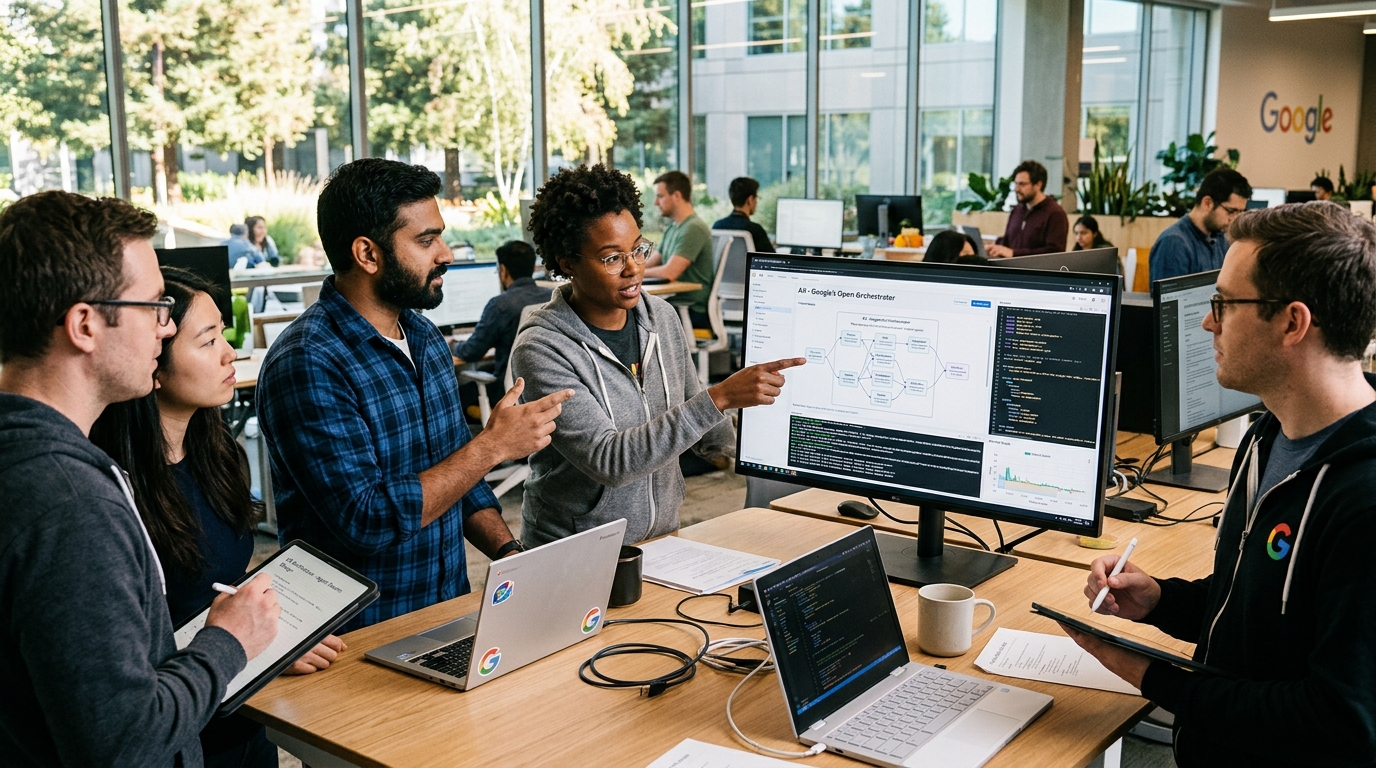


AX: Google’s Open Orchestrator and the Dawn of Agent-Centric Computing
Google open-sourced AX. Not a model. Not a paper. An orchestrator built for agents that run for hours, keep state, and burst compute like a caffeine-fueled intern. This isn’t incremental. It’s the first serious bet that agents—stateful, long-running, unpredictable—will need their own infrastructure layer. And if they’re right, everything from Kubernetes to serverless looks like a legacy system overnight.
---
The Agentic Workload Problem: Why Everything Breaks
Agents don’t fit. They’re not stateless functions. They’re not batch jobs. They’re not microservices. They run for hours. They remember. They wait. They explode into compute for thirty seconds, then idle for five minutes while a tool or human responds. Then they do it again.
Look at the numbers:
- Duration: Hours, not milliseconds.
- Compute pattern: Bursty. 30 seconds of GPU crunch, 5 minutes of waiting.
- State: Non-negotiable. Agents remember past actions, adapt goals, evolve.
Kubernetes? Built for stateless, predictable workloads. Serverless? Designed for functions that start, finish, and never resume. Batch systems? They assume jobs terminate. None of them handle the compute-wait-compute cycle. None of them were built for agents.
This isn’t a tweak. It’s a fundamental mismatch. And AX is Google’s attempt to fix it.
---
AX’s Origin: Google’s Secret Weapon
AX wasn’t cooked up in a side project. It’s the collision of two of Google’s biggest strengths: DeepMind’s agentic runtime research and Google’s decades of experience building large-scale isolation and scheduling systems.
DeepMind has been running ReAct, chain-of-thought, and multi-step reasoning agents in production for years. Meanwhile, Google’s infrastructure teams have built Borg, Kubernetes, and Isolate—systems that manage stateful, large-scale workloads. AX is the fusion of those two worlds.
Why open-source it now? Because AX isn’t finished. It’s an experiment. Google is saying: we don’t have all the answers, and the space is still wide open. They’re betting on co-development, not control.
---
AX’s Architecture: A Declarative Control Plane for Agents
AX isn’t just another framework. It’s a declarative control plane built for agent execution. Developers define what an agent should do—goals, constraints, tools—not how it should execute.
Here’s what that means:
- Stateful execution: AX manages agent state natively. No more offloading state to Redis or praying your framework can handle resumption.
- Isolation and resumption: Drawing on Google’s Isolate, AX can pause, resume, and migrate agents without losing context.
- Scheduling for bursty workloads: Designed for the compute-wait-compute cycle, optimizing resource allocation during idle periods.
This is a big deal. Most agent frameworks today—LangChain, LlamaIndex—are glorified tool-chaining libraries. They’re great at composing models and APIs, but they punt on execution, scheduling, and state management. AX fills that gap.
But let’s be clear: AX isn’t replacing Kubernetes or serverless. It’s complementing them. Kubernetes is for stateless, predictable workloads. Serverless is for short-lived functions. AX is for agents—workloads that are stateful, bursty, and long-running.
---
Technical Deep Dive: How AX Works Under the Hood
Installation and Tooling
Getting started is simple. The CLI installs via a single command: ``bash go install github.com/google/ax/cmd/ax@latest ``
No Docker. No Kubernetes. No complex setup. Just a Go binary. This isn’t an accident. AX is designed to be lightweight, accessible, and opinionated.
Runtime Components
AX combines three key components into a unified orchestrator:
- Scheduler: Handles the bursty compute patterns of agents, allocating resources efficiently during idle periods.
- State manager: Maintains agent state natively, preserving context across pauses and resumptions.
- Isolation layer: Borrows from Google’s Isolate to run agents in secure, sandboxed environments.
Comparison to Alternatives
Most agent frameworks today are tool-chaining libraries. LangChain and LlamaIndex excel at composing models and APIs, but they don’t handle execution, scheduling, or state management. They punt on the hard problems. AX doesn’t.
Kubernetes? Great for stateless workloads, but it struggles with statefulness and bursty compute. Serverless? Designed for short-lived functions, not agents that run for hours. AX isn’t competing with these tools—it’s filling a gap they can’t.
Open Questions
AX doesn’t answer everything. Not yet.
- Fault tolerance: How does AX handle agent failures? Can it recover gracefully, or does a crash mean lost state?
- Scaling: Can it handle thousands of concurrent agents, or is it limited to smaller deployments?
- Multi-agent coordination: How does AX manage interactions between multiple agents working toward a shared goal?
These aren’t minor details. They’re fundamental challenges. And right now, AX doesn’t have answers. But that’s the point—it’s an experiment, not a finished product.
---
The Broader Implications: A New Computing Paradigm?
AX isn’t just a tool. It’s a signal. Google is betting that agents—stateful, long-running, bursty—will define the next era of computing. And if that bet pays off, AX could become the foundation for a new wave of infrastructure.
Agent-Centric Infrastructure
We’ve seen this before. Kubernetes emerged as the standard for container orchestration. Lambda defined serverless computing. AX could do the same for agents.
But this isn’t just about Google. The rise of agent-centric infrastructure could mirror the container and serverless revolutions:
- Developers: Lower barriers to building stateful, long-running agents.
- Enterprises: New use cases for automation, customer support, and internal tooling.
- Research: Stateful, multi-agent simulations for economics, robotics, and more.
Enterprise vs. Research Use Cases
AX’s potential spans two broad categories:
- Enterprise: Long-running agents for customer support, internal tooling, or autonomous workflows. Imagine an agent that handles a customer inquiry from start to finish, maintaining context across hours or days.
- Research: Stateful, multi-agent simulations. Think economic models, robotics, or complex decision-making scenarios where agents interact over extended periods.
Google’s Motivation
Why open-source AX now? A few possibilities:
- Ecosystem play: Drive adoption of Google Cloud for agent hosting.
- Research bet: Shape the standards for agent infrastructure before competitors do.
- Community co-development: Leverage external contributions to accelerate AX’s development.
Whatever the reason, Google’s move is a gamble. And if it pays off, AX could become the de facto standard for agent orchestration.
---
The Catch: AX’s Limitations and Unanswered Questions
AX is exciting. But it’s not ready for production. Here’s what’s missing.
Experimental Status
AX is an experiment. It’s not a polished product. Google’s open-source release suggests it’s still a work in progress—and that the space is far from settled.
Missing Pieces
- Observability: How do developers debug stateful, long-running agents? AX doesn’t yet provide clear answers. Logs, traces, and metrics are minimal.
- Security: How does AX handle isolation in multi-tenant environments? This is critical for enterprise adoption, and it’s not yet clear how AX addresses it.
- Scaling: Can AX handle thousands of concurrent agents, or is it limited to smaller deployments? The brief doesn’t say.
Competition
AX isn’t the only player in this space. Startups like Imbue and Adept are building proprietary agent runtimes. And while AX’s openness is a strength, it could also be a weakness if competitors outpace it in features or performance.
Adoption Hurdles
Most developers today are using simpler frameworks like LangChain. Until agentic workloads become mainstream, AX’s appeal may be limited to early adopters and researchers. And even then, the learning curve could be steep.
---
What’s Next? The Roadmap for AX and Agent Infrastructure
AX’s future depends on three things:
- Google’s commitment: Will Google invest in AX long-term, or is this a side project that fades into obscurity?
- Community contributions: AX’s success hinges on external developers adding plugins, integrations, and use cases.
- Competition: Will AWS, Azure, and others release competing agent orchestrators? And if they do, will they outpace AX?
Near-Term Goals
Google’s immediate focus is likely on stability, documentation, and community engagement. AX needs to become more accessible—and more robust—before it can gain widespread adoption. Expect improvements in observability, debugging, and scaling in the coming months.
The Bigger Picture
If AX gains traction, expect a wave of competing orchestrators.
- Cloud wars: AWS, Azure, and others won’t sit idle. Expect competing agent orchestrators, each with their own strengths and weaknesses.
- Regulation: Stateful, long-running agents raise questions about accountability, data retention, and compliance. How will regulators respond?
---
Hands-On: Trying AX Today
Want to try AX for yourself? Here’s how to get started.
Installation
The AX CLI installs via a single command: ``bash go install github.com/google/ax/cmd/ax@latest ``
Example Workflow
Let’s define a simple agent—a research assistant that gathers information on a given topic.
1.
- Specify tools: Web search, document summarization, citation tracking.
- Set constraints: Time limit, maximum number of sources, output format.
AX’s declarative syntax lets you define what the agent should do, not how it should execute. The orchestrator handles the rest—scheduling, state management, isolation.
Limitations Encountered
AX is experimental, so expect rough edges:
- Documentation: Limited examples and guides. The learning curve is steep.
- Debugging: Observability tools are minimal. Debugging stateful, long-running agents is challenging.
- Scaling: Performance may degrade with complex agents. The system isn’t yet optimized for large-scale deployments.
But for early adopters, AX offers a glimpse into the future of agent infrastructure. It’s not polished, but it’s a start.
---
The Big Picture: Why AX Matters Beyond Google
AX isn’t just a tool. It’s a signal. Google is betting that agents will define the next era of computing. And if that bet pays off, AX could become the foundation for a new wave of infrastructure.
For Developers
AX lowers the barrier to building stateful, long-running agents. But it’s not a silver bullet. Developers will need to adapt to a new paradigm—one where agents, not models, drive execution. The learning curve is steep, and the tooling is immature. But for those willing to experiment, AX offers a glimpse into the future.
For Enterprises
Early adopters could gain a competitive edge in agentic automation. Imagine customer support agents that handle inquiries from start to finish, or internal tools that automate complex workflows. But risks remain. AX is experimental, and the space is still evolving. Enterprises will need to weigh the potential benefits against the uncertainty.
For the AI Ecosystem
AX could catalyze a wave of agent-centric startups, tools, and infrastructure. If Google’s bet pays off, we could see a new ecosystem emerge—one built around stateful, long-running agents. And if it doesn’t, AX could fade into obscurity, a footnote in the history of AI infrastructure.
For Google
AX is a chance to shape the future of agent infrastructure. But it’s also a distraction from Google’s core businesses. Time will tell whether this bet pays off. If it does, AX could become the de facto standard for agent orchestration. If it doesn’t, it could join the graveyard of Google’s abandoned experiments.
---
The Open Question
AX is a bold experiment. It’s also a reminder that the space is still wide open. Will AX become the "Kubernetes for agents," or will the future of agent infrastructure look entirely different?
That’s the question. And the answer will shape the next decade of computing.
Sources
Key Takeaways
- The evolution of Blog continues to accelerate rapidly.
- Experts like Auto Bot suggest staying informed on these specific developments.
- Consider the broader implications for the tech industry moving forward.