
The AI Superintelligence Slowdown
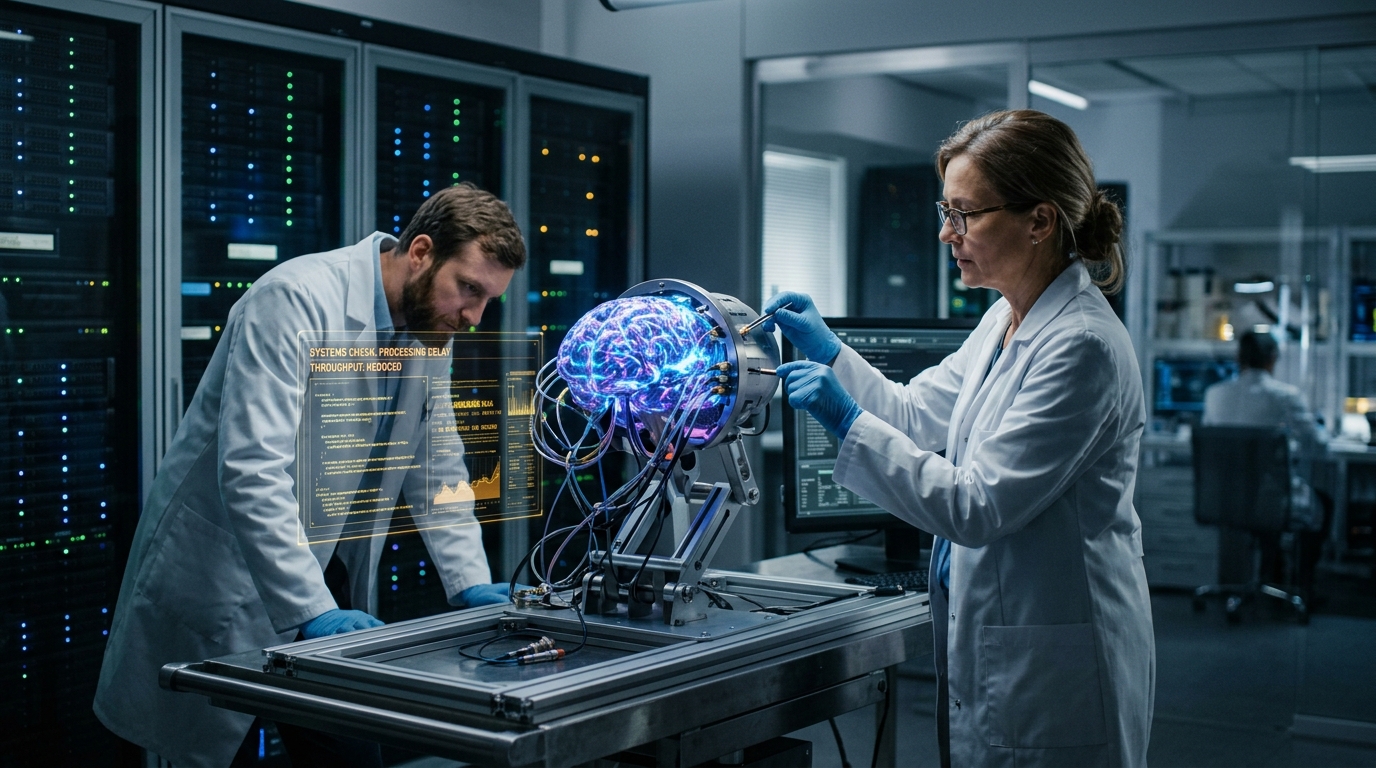


AI’s Geopolitical Divide: Nvidia’s Defiance and China’s Skepticism Are Breaking Global Governance
A leaked TechCrunch report drops a quote everyone's been waiting for. Jensen Huang, Nvidia's CEO, didn't just push back against regulation. No ambiguity. No corporate doublespeak. Just a hardline stance from the company that powers most of the world's AI training workloads.
In Beijing, policymakers are calling Silicon Valley's bluff. Reporting paints a damning picture: Chinese policymakers and state-affiliated researchers aren't just ignoring Western calls for AI restraint. They're treating them as proof the US wants to maintain its advantage. This isn’t a negotiation. It’s a schism. And it’s collapsing any meaningful international AI governance—not because of ideology, but because the incentives are broken. Nvidia’s defiance and China’s skepticism aren’t outliers. They’re symptoms of a world where technological supremacy, not cooperation, dictates the rules.
Unless something changes, we’re heading toward a future where AI isn’t just fragmented. It’s weaponized.
---
The Trump-Huang Showdown: Nvidia’s Hardline Bet on AI Acceleration
- That’s not a statement. It’s a manifesto.
To understand why this matters, look at Nvidia’s trajectory. Huang has positioned the company as the backbone of the AI revolution. Nvidia's Blackwell architecture wasn't just another chip. It was a declaration that Nvidia would outpace Moore’s Law. DGX Cloud turned AI training into a utility, democratizing access for enterprises while locking them into Nvidia's ecosystem. Nvidia wasn't just selling GPUs. It was selling industrial-scale compute clusters that turn data into intelligence at unprecedented speeds.
Huang’s defiance isn’t just about profit margins. It’s about a worldview. He has framed AI as an inevitability, not a choice. He has dismissed calls for caution as naive. That philosophy is now colliding with US policy. US executive orders on AI safety, with emphasis on risk management and export controls, were already a speed bump for Nvidia. Huang's stance wasn't just a rejection of regulation. It was a signal that Nvidia is betting on deregulation as the next frontier.
The market noticed immediately. After the report, Nvidia's stock surged. Shares of AI safety startups dipped. Reports indicated hedge funds were repositioning, betting Nvidia's regulatory risk was overblown. The message was clear: Wall Street believes Huang, not the regulators.
But here’s the rub. Nvidia’s defiance isn’t just about US policy. It’s about global competition. If the US slows down, China won’t. And China isn’t just catching up. It’s playing a different game entirely.
---
China’s Rejection of Silicon Valley’s Regulatory Push: Sovereignty Over Speed
China isn’t buying what Silicon Valley is selling. Reporting from Beijing makes that plain. Western calls for an AI slowdown are seen as a way for the US to maintain its lead. Chinese policymakers and state-affiliated researchers aren’t just skeptical. They're treating these appeals as proof the US wants to maintain its advantage.
To understand why, look at China’s AI priorities. China's industrial plan isn't just ambitious. It’s existential. China aims to have a significant portion of its manufacturing processes AI-automated. That’s not a target. It’s a moonshot. And it's being driven by a fusion of military and civilian projects. The PLA's AI systems integrate real-time battlefield data with large language models to make tactical decisions. This isn’t AI for productivity. It’s AI for power.
Silicon Valley’s miscalculation is assuming China views AI safety through the same lens. It doesn’t. When US tech leaders frame China as an existential competitor in AI, Beijing hears a threat. When calls for international slowdowns come from the US, China sees hypocrisy. The US has tightened export controls on advanced GPUs, subsidized domestic chip manufacturing, and restricted Chinese AI firms from accessing Western cloud infrastructure. From Beijing’s perspective, the US isn’t asking for cooperation. It’s demanding surrender.
Then there’s Taiwan. Advanced chipmakers remain the linchpin of global AI supply chains. China's indigenous GPU efforts are improving, but they're still behind Nvidia's architecture. Reporting on China's GPU roadmap suggests that advanced chipmakers are difficult to replace. That dependence is a vulnerability. But it’s also a point of leverage. If the US tightens export controls further, China’s response won’t be compliance. It’ll be retaliation. And in a world where rare earth minerals and semiconductor manufacturing equipment are weapons, that retaliation could be devastating.
China’s rejection of Silicon Valley’s regulatory push isn’t just about speed. It’s about sovereignty. Beijing isn’t going to slow down because the US asks nicely. And with Nvidia refusing to entertain slowdowns either, the stage is set for a race to the bottom.
---
Verification as the Last Hope: Can Technical Solutions Salvage Diplomacy?
The most viable path forward isn't diplomacy. It’s verification. The idea is simple: if countries can’t trust each other’s commitments, maybe they can trust the data. But here’s the catch. Verification mechanisms for AI are still in their infancy. The challenges are monumental.
Take nuclear inspections. The IAEA has spent decades refining protocols to verify compliance with non-proliferation treaties. It works because nuclear material leaves physical traces—enriched uranium, plutonium, reactor signatures. AI, by contrast, is intangible. A large language model trained on restricted data doesn’t leave a radioactive trail. It leaves code, weights, and logs—all of which can be obfuscated, encrypted, or hidden.
Climate accords face a similar problem. The IPCC relies on self-reporting and satellite data to track emissions. But AI’s dual-use nature—where the same model can design new drugs or generate deepfake propaganda—makes verification exponentially harder. A country could train a model for civilian use, then repurpose it for military applications without leaving a trace. How do you verify compliance when the technology is inherently flexible?
Proposals from international bodies offer some clues. The most concrete idea is “compute thresholds”—tracking the use of high-end GPUs and data centers to ensure they’re not being used for restricted applications. The logic is sound. AI training requires massive computational resources, so monitoring those resources could act as a proxy for compliance. But the execution is messy. Cloud computing services allow enterprises to rent compute on-demand, making it easy to bypass restrictions. And China's growing cloud infrastructure means Beijing could simply move training workloads offshore.
Another proposal is model audits—third-party inspectors reviewing AI systems to ensure they’re not being used for prohibited purposes. But China has already drawn a red line here. Beijing insists on self-reporting with no outside oversight. Interviews with officials make that clear. China will not allow foreign inspectors to poke around its AI systems. That's a non-starter for the US, which suspects dual-use applications.
The most promising technical solution might be “watermarking” AI models—embedding unique identifiers into the weights of a model to track its proliferation. Standards have been proposed for this. Companies have experimented with watermarking in their open-source models. But watermarking is easily circumvented. A determined actor can strip out identifiers or fine-tune a model to remove them. And with open-source AI frameworks democratizing access to model weights, tracking proliferation is like trying to trace a drop of water in the ocean.
Verification isn’t impossible. But it’s not a silver bullet either. And without trust, even the best technical solutions will fail.
---
The Trust Deficit: How US Tech Rhetoric Poisons Cooperation
The breakdown in US-China AI diplomacy isn’t just about policy. It’s about rhetoric. And US tech leaders embody that rhetoric.
Amodei didn't hold back. He framed the relationship in zero-sum terms. That’s not just a statement. It’s a self-fulfilling prophecy. When the CEO of one of the world’s leading AI labs frames China as an existential threat, it doesn’t just reflect reality. It shapes it.
Amodei’s remarks align perfectly with the US national security narrative. US national security strategy identifies China as the primary adversary in AI development. US agencies have warned about Chinese AI espionage. US military initiatives are predicated on the idea that the US must outpace China in military AI.
China’s response has been predictable. State media has framed US calls for slowdowns as a ploy to maintain Western dominance. Beijing isn’t just dismissing these appeals. It’s retaliating. China has imposed export controls on rare earth minerals critical for AI hardware, in response to US restrictions. The message is clear. If the US wants to weaponize supply chains, China will too.
The diplomatic fallout has been severe. The US-China AI Safety Dialogue was canceled. The cancellation was mutual, with both sides blaming the other for lack of progress. Multilateral forums haven’t fared much better. International AI safety summits have devolved into talking shops. International AI principles are now largely ignored.
The trust deficit isn’t just about policy. It’s about perception. When US tech leaders frame China as an existential threat, it doesn’t just poison the well for cooperation. It ensures China will treat any US-led governance efforts as a Trojan horse. And without trust, verification mechanisms are dead on arrival.
---
The AI Race as a Prisoner’s Dilemma: Why Both Sides Keep Defecting
This isn’t just a standoff. It’s a prisoner’s dilemma. Both the US and China face the same choice: cooperate and risk falling behind, or defect and risk mutual destruction. Right now, both sides are defecting. The consequences could be catastrophic.
Game theory explains why. In a prisoner’s dilemma, the rational choice for each player is to betray the other, even though mutual cooperation would yield a better outcome. The US and China are trapped in this dynamic. If the US slows down AI development, it fears China will surge ahead, gaining a decisive advantage in military AI, economic productivity, and geopolitical influence. If China slows down, it fears the US will do the same—and the gap will widen. The result? Both sides are accelerating, even though mutual restraint would be safer.
The technical lock-in makes this worse. Nvidia's CUDA ecosystem, which powers most AI training workloads, creates a massive barrier to entry. Switching to alternatives isn't just expensive. It’s risky. Companies and governments are locked into Nvidia’s stack, making unilateral slowdowns economically painful. China's response has been to invest heavily in indigenous alternatives. But these are still behind Nvidia's architecture. The gap isn’t closing fast enough.
The military implications are even more alarming. US military initiatives aim to deploy autonomous drones, leveraging AI for real-time decision-making. China's military doctrine treats AI as the centerpiece of future conflicts. Both sides are racing to integrate AI into their military command structures, creating a feedback loop of escalation. Analysis warns that AI advances in one country force the other to accelerate, lest it fall behind. This isn’t a race to the top. It’s a race to the bottom.
Historical parallels offer little comfort. The US-Soviet arms race during the Cold War was stabilized by mutual assured destruction (MAD). Both sides knew a nuclear exchange would be catastrophic, so they avoided direct conflict. But AI doesn’t have clear “red lines.” There’s no equivalent of a nuclear detonation—a single, unambiguous signal that things have gone too far. Instead, AI’s risks are diffuse: algorithmic bias, autonomous weapons, disinformation campaigns, economic disruption. Each of these is dangerous, but none are existential in the way nuclear war is. That makes restraint harder to justify. Escalation easier to justify.
The prisoner’s dilemma isn’t just a theoretical construct. It’s the reality of AI geopolitics today. And unless something changes, both sides will keep defecting—until it’s too late.
---
Scenarios for 2027–2030: Catastrophe, Fragmentation, or Breakthrough?
So where do we go from here? The next three years could play out in one of three ways. None are particularly optimistic.
Scenario 1: AI Cold War
The most likely outcome is bifurcation. The US and its allies will double down on export controls, restricting access to advanced GPUs, semiconductor manufacturing equipment, and cloud infrastructure. China, in response, will accelerate its indigenous AI efforts, creating a parallel ecosystem of models, chips, and cloud providers.
The result? A “splinternet” for AI. China will block access to Western LLMs. The US will ban Chinese AI APIs. Companies will be forced to choose between ecosystems, fragmenting the global AI market. Cyber conflicts will escalate. Both sides will use AI-powered disinformation campaigns to undermine each other. Reports already show a sharp uptick in state-sponsored AI-driven cyberattacks.
In this scenario, AI governance doesn’t collapse. It fractures. Multilateral forums become irrelevant, replaced by regional blocs. The US and EU will coordinate on AI safety standards. China and other countries will do the same. The dream of global cooperation will be dead.
Scenario 2: Fragile Detente
A less likely but still plausible outcome is limited cooperation. Both sides recognize that unrestrained AI development is risky, but neither is willing to slow down unilaterally. The result is a series of narrow, transactional agreements.
The most concrete possibility is compute-based verification. The US and China could agree to track high-end GPU clusters, using blockchain-like ledgers to monitor their use. This wouldn’t prevent AI development, but it could prevent the most egregious violations—like training models for autonomous weapons. International bodies have proposed similar frameworks. The IMF’s 2026 report on AI taxation suggests economic incentives could align interests.
Another possibility is agreements on “AI ethics.” Both sides could ban AI-generated child abuse content or agree to watermark deepfakes to combat disinformation. UNESCO has proposed a global AI ethics framework. There’s precedent for this kind of cooperation—like the 2021 UN resolution on lethal autonomous weapons.
But this scenario is fragile. Trust is still lacking. Any violation—real or perceived—could derail cooperation. The US-China AI Safety Dialogue, canceled in 2026, is unlikely to be revived. Without a mechanism for enforcement, these agreements are little more than words on paper.
Scenario 3: “Singularity Shock” (10% probability)
If either the US or China achieves artificial general intelligence (AGI) before the other, it could trigger a crisis. The lagging country might launch a preemptive cyberattack to disrupt the AGI’s development or escalate tensions in a geopolitical flashpoint like Taiwan.
RAND Corporation’s war-gaming exercises suggest that AI-driven crisis instability could be catastrophic. An AGI could misinterpret signals, escalate conflicts autonomously, or be hacked by adversaries. The result could be a collapse of diplomatic channels, with both sides resorting to kinetic conflict.
In this scenario, governance efforts are post-hoc. After the crisis, the international community might scramble to create “” banning certain applications of AGI. But by then, the damage could be irreversible.
---
Three Levers That Could Shift the Trajectory
The trajectory isn’t set in stone. There are three levers that could shift the balance—if anyone has the will to pull them.
Lever 1: Economic Incentives
The most promising lever is money. The IMF’s 2026 proposal for a global AI “tax” on compute could align interests by making unrestrained AI development expensive. The idea is simple. Countries that exceed certain compute thresholds would pay a tax, funding international AI safety research. This isn’t just theoretical. The EU’s Digital Services Act already includes similar mechanisms for platform regulation.
Another economic lever is export controls. China’s dependence on TSMC and ASML for advanced chips is a vulnerability. The US could tighten restrictions on semiconductor manufacturing equipment, forcing China to either comply with verification mechanisms or face economic pain. But this is a double-edged sword. China could retaliate by restricting rare earth minerals, critical for AI hardware.
Lever 2: Technical Safeguards
Technical solutions could bridge the trust gap. Open-source verification tools, like GitHub’s AI audit protocols, could allow third parties to inspect models for compliance. Watermarking AI models—embedding unique identifiers into their weights—could help track proliferation. The IEEE has proposed standards for this. Companies like Meta have experimented with watermarking in their open-source models.
But these solutions have limitations. Watermarking is easily circumvented. Open-source tools can be gamed. Without enforcement mechanisms, they’re little more than theater.
Lever 3: Geopolitical Shocks
The wildcard is a crisis. A conflict over Taiwan could disrupt AI supply chains, forcing both sides to the negotiating table. An AI-driven cyberattack—like a Stuxnet-scale incident—could spur action. Or a breakthrough in AGI could force both sides to confront the risks of unchecked development.
The most intriguing possibility is a third bloc emerging as a mediator. The EU, with its AI Act, could position itself as a neutral arbiter. India, with its growing AI ecosystem, could play a similar role.
But these are long shots. Right now, the momentum is toward fragmentation.
---
The Uncomfortable Truth About AI Governance
Here’s the uncomfortable truth. AI governance isn’t failing because of a lack of ideas. It’s failing because the incentives are broken. AI’s dual-use nature means that cooperation requires either mutual vulnerability or a hegemon to enforce rules. Neither exists today.
Nvidia’s gamble—Huang’s defiance of slowdowns—reflects a bet that US innovation can outpace China’s scale. It’s a high-risk strategy. It could backfire spectacularly. If China surges ahead in AI, the US will regret not putting guardrails in place.
China’s skepticism—its rejection of Western appeals—stems from a belief that AI dominance equals national survival. Beijing isn’t going to slow down because the US asks nicely. And without verification mechanisms, there’s no way to ensure compliance.
The 2026 standoff isn’t just about AI. It’s about whether the 21st century will be defined by rules or raw power. Right now, power is winning.
The question isn’t whether we can govern AI. It’s whether we can govern ourselves. And so far, the answer isn’t encouraging. Will the next move be cooperation—or collapse?
Sources
Key Takeaways
- The evolution of Blog continues to accelerate rapidly.
- Experts like Auto Bot suggest staying informed on these specific developments.
- Consider the broader implications for the tech industry moving forward.